Steel pipes are fundamental components in various industries, including oil and gas, construction, automotive, and manufacturing. The two primary types of steel pipes – seamless pipes and welded pipes – differ significantly in their manufacturing processes, structural properties, and applications. This detailed comparison examines these differences across multiple dimensions to help professionals make informed decisions for specific applications.
What is a seamless pipe?
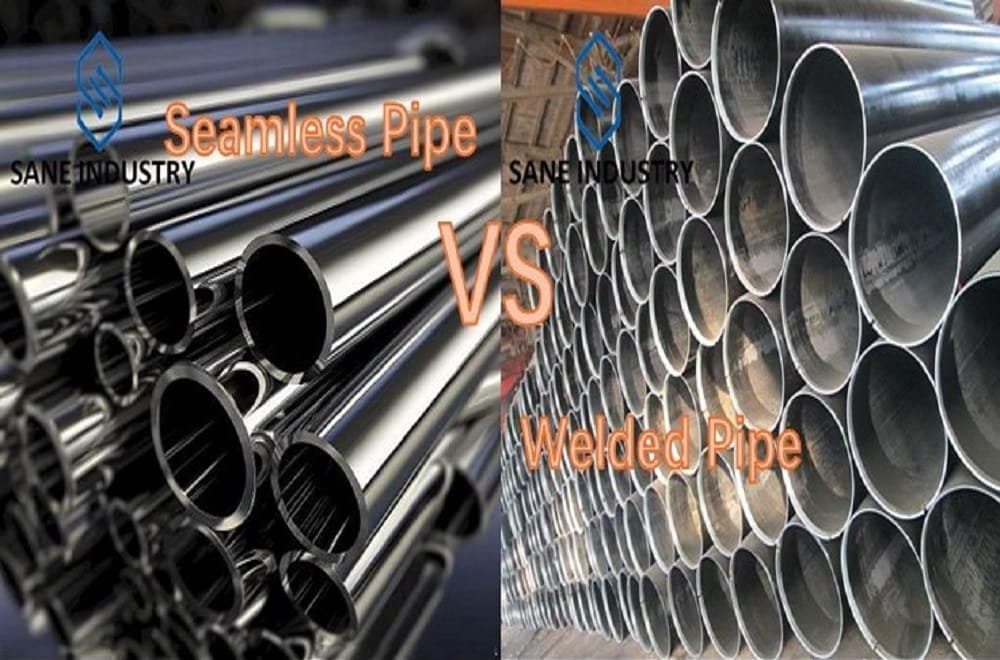
A seamless pipe is a cylindrical steel tube manufactured without any welded joints, created by piercing a solid billet and rolling it into a continuous hollow structure. This production method results in uniform wall thickness and homogeneous material properties, making seamless pipes ideal for high-pressure, high-temperature, and critical applications in industries like oil and gas, power plants, and hydraulic systems. Their superior strength, pressure resistance, and reliability come at a higher cost compared to welded alternatives due to the complex manufacturing process and material waste involved.
What is a welded pipe?
A welded pipe, also known as a welding pipe or welded steel pipe, is a cylindrical steel tube manufactured by rolling steel plates or coils into shape and joining the edges through welding processes such as ERW (Electric Resistance Welding) or SAW (Submerged Arc Welding). This method allows for cost-effective production in various diameters and lengths, making welded pipes suitable for applications like water distribution, structural frameworks, and low-pressure pipelines. While they may exhibit slight variations in wall thickness near the weld seam and require additional quality control for weld integrity, welded pipes offer a practical balance of performance and affordability compared to seamless alternatives.
Differences Between Seamless Pipes and Welded Pipes:
| Feature | Seamless Steel Pipes | Welded Pipes |
|---|---|---|
| Manufacturing Process | produced by extruding a solid billet through a piercing rod to create a hollow tube without any seams. The process involves heating the billet and rolling it under high pressure, resulting in a uniform structure | made by rolling metal sheets or coils into a cylindrical shape and welding the edges together. Common welding methods include Electric Resistance Welding (ERW), Submerged Arc Welding (SAW), and High-Frequency Induction Welding (HFIW) |
| Structure | No seams or welds along its length; uniform wall thickness | Seam or weld line along its length |
| Appearance | Have a smooth, uniform surface without visible weld lines | Often exhibit weld seams, which may be polished or treated for aesthetic purposes but remain detectable |
| Wall Thickness and Dimensions | Tend to have inconsistent wall thickness due to manufacturing constraints, especially in larger diameters | Offer more precise control over wall thickness and dimensions, making them ideal for standardized applications |
| Strength and Durability | Generally stronger and more reliable under high pressure due to their homogeneous structure. They are preferred for critical applications like oil and gas pipelines | While modern welding techniques improve strength, welded pipes may have weaker points along the weld seam, making them less suitable for extreme pressure conditions |
| Pressure and Temperature Resistance | Suitable for high-pressure and high-temperature applications | Less suitable for extreme pressure or high temperature conditions |
| Corrosion Resistance | Less prone to corrosion due to the absence of weld seams, which can be vulnerable to chemical attack | May require additional treatments (e.g., galvanizing) to enhance corrosion resistance, especially in harsh environments |
| Cost and Production Time | More expensive and time-consuming to produce due to complex manufacturing processes | Cost-effective and faster to manufacture, making them suitable for large-scale projects with budget constraints |
| Applications | Used in high-pressure environments like refineries, petrochemical plants, and hydraulic systems | Commonly employed in water supply, structural projects, and low-pressure fluid transport |
| Advantages | Ideal for oil/gas pipelines (API 5CT) and boiler tubes (ASTM A179) where internal pressures exceed 3000 psi. No weld seams eliminate crevice corrosion risks in chemical processing (ASME B36.10M). | Available in a wide range of sizes, including large diameters, catering to diverse industrial needs. 30-50% cheaper than seamless for low/medium pressure applications. |
| Disadvantages | Maximum diameter limited to 24″ due to billet size constraints. Longer lead times (4-6 weeks for custom sizes). | Weld defects (lack of fusion, porosity) require rigorous NDT. |
Conclusion
The choice between seamless and welded pipes depends on a careful evaluation of application requirements, performance needs, and budget constraints. Seamless pipes offer superior strength, pressure resistance, and reliability in critical applications, while welded pipes provide cost-effective solutions for less demanding environments. Understanding these fundamental differences allows engineers and procurement professionals to select the optimal pipe type for each specific application.