What is a Carbon Steel Pipe
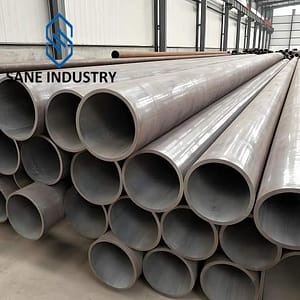
A carbon steel pipe is a type of steel piping primarily composed of iron and carbon, with trace amounts of other elements such as manganese, silicon, and copper. The carbon content typically ranges between 0.05% and 2.0%, which directly influences the pipe’s strength, hardness, and ductility. Unlike stainless steel pipes or alloy steel pipes, carbon steel pipes lack significant amounts of chromium or nickel, making them more cost-effective but less resistant to corrosion.
Types of Carbon Steel Pipes
- Based on carbon content
- Low Carbon Steel Pipes (≤0.25% carbon): Characterized by excellent ductility and weldability, these pipes are commonly used for water distribution and low-pressure applications. ASTM A53 Grade B represents a typical specification for this category.
- Medium Carbon Steel Pipes (0.25%-0.6% carbon): Offering balanced strength and toughness, these pipes find applications in mechanical components and medium-pressure systems.
- High Carbon Steel Pipes (>0.6% carbon): With superior hardness and wear resistance, these specialized pipes are used in tooling and wear-resistant applications, though the “steel tube” designation is more common for these precision applications.
- Based on manufacturing process
- Seamless Carbon Steel Pipes: Produced through hot working processes where a solid billet is pierced and rolled into a hollow form. These pipes exhibit uniform material properties throughout their cross-section.
- Welded Carbon Steel Pipes: Manufactured by forming flat steel plates into cylindrical shapes and joining the edges through welding processes (ERW, SAW, or spiral welding). The term “steel tube” is often applied to welded products with tighter dimensional tolerances.
- Based on shape
- Carbon Steel Square Pipe
- Carbon Steel Rectangular Pipe
- Carbon Steel Round Pipe
- Based on surface treatment
- Galvanized Carbon Steel Pipe: Coated with zinc to resist corrosion; common in plumbing and fencing (e.g., ASTM A53).
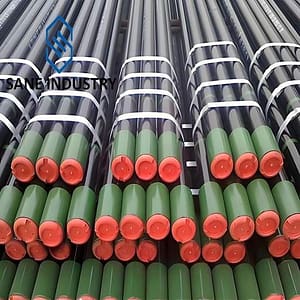
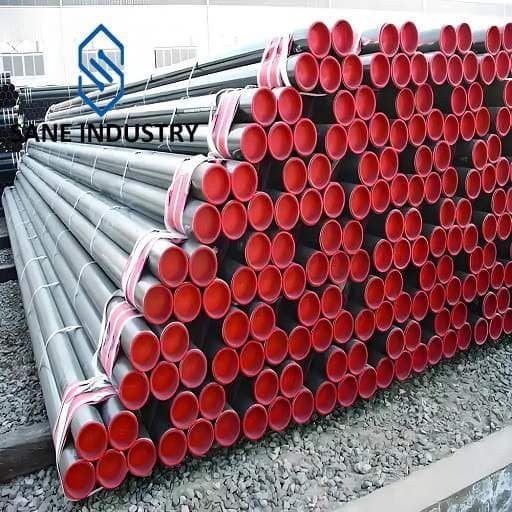
- Black Steel Pipe: Uncoated, used for gas/oil transportation or structural purposes.
What are the Advantages of Carbon Steel Pipes
- Cost-Effectiveness
- Lower material cost: 30-50% cheaper than stainless steel/alloy pipes, ideal for large-scale infrastructure (e.g., urban water supply systems).
- Reduced fabrication expenses: Easily welded or machined without specialized equipment.
- High Strength-to-Weight Ratio
- Tensile strength ranges from 370 MPa (low-carbon) to 630 MPa (high-carbon), suitable for structural supports (e.g., building frameworks).
- Maintains integrity under cyclic loads (e.g., hydraulic systems in machinery).
- Versatile Fabrication
- Compatible with hot rolling, cold drawing, and spiral welding processes.
- Seamless variants (e.g., ASTM A106 Grade B) withstand pressures up to 32 MPa.
- Recyclability
- Fully recyclable, aligning with sustainability goals in construction and manufacturing.
What are the Disadvantages of Carbon Steel Pipes
- Poor Corrosion Resistance
- Prone to rust in humid or chemical environments (e.g., coastal pipelines) without coatings like galvanization.
- Annual corrosion rate in untreated pipes: 0.1–0.2 mm/year in moderate climates.
- Temperature Sensitivity
- Long-term use limit: ≤450°C; beyond this, oxidation and creep deformation accelerate.
- Unsuitable for cryogenic applications (e.g., LNG transport) due to brittleness below -29°C.
- Weight Constraints
- Higher density (~7.85 g/cm³) compared to aluminum/composite pipes, increasing transport/installation costs.
- Maintenance Demands
- Requires periodic inspections and protective coatings in corrosive environments (e.g., chemical plants).
How are Carbon Steel Pipes made
Carbon steel pipes are produced through two primary methods: seamless (hot-rolled or cold-drawn) and welded (with seams). Below is a detailed breakdown of the key steps and variations:
Material Selection
- Carbon steel billets or coils are chosen, with carbon content (0.1–0.3%) and alloying elements (Mn, Si) tailored for strength and weldability.
Forming Techniques
- Seamless:
- Heated billets pierced via rotary/press methods, then elongated through extrusion or cold drawing.
- Welded:
- ERW: Coils shaped into tubes and fused using electric resistance welding.
- SAW: Steel plates rolled and welded longitudinally (LSAW) or spirally (SSAW) under submerged arc flux.
- Seamless:
Heat Treatment
- Processes like annealing, normalizing, or quenching/tempering optimize mechanical properties and eliminate residual stresses.
Quality Testing
- Hydrostatic pressure tests, non-destructive inspections (ultrasonic, X-ray), and dimensional accuracy checks.
Surface Protection
- Coatings (galvanizing, epoxy, FBE) or sandblasting applied to resist corrosion and abrasion.
Final Certification
- Marked with compliance to standards (ASTM, ASME) and critical data (grade, thickness, test results).
Applications of Carbon Steel Pipes
- Oil & Gas: Transport crude oil, gas, and steam in high-pressure pipelines, refineries, and offshore rigs.
- Construction: Structural frameworks (beams, columns), water supply lines, and HVAC systems.
- Automotive: Exhaust systems, hydraulic components, and fuel lines for durability under stress.
- Power Plants: Boiler tubes and steam conduits in coal, nuclear, and geothermal energy systems.
- Agriculture: Irrigation sprinklers, drainage networks, and machinery parts resistant to soil corrosion.
- Mining: Slurry transport, compressed air systems, and abrasive material handling.
- Emerging Uses: Hydrogen pipelines for green energy and carbon capture infrastructure.
How to Select Carbon Steel Pipes Correctly
Define Application Requirements
- Pressure & Temperature: Choose seamless pipes for high-pressure systems (≥72 bar) or extreme temperatures; welded pipes (ERW/SAW) suffice for low-pressure utilities.
- Fluid Type: Acidic or corrosive fluids demand coated pipes (FBE, 3LPE) or higher-grade alloys (e.g., 16Mn).
Material & Grade Selection
- Carbon Content: Opt for low-carbon steel (0.1–0.3% C) for weldability and ductility; medium/high-carbon grades prioritize strength.
- Compliance: Ensure alignment with standards (e.g., ASTM A53, API 5L PSL1/PSL2) for structural integrity.
Manufacturing Method
- Seamless Pipes: Ideal for critical applications (oil/gas pipelines) due to uniform strength; cold-drawn variants offer precision for machinery parts.
- Welded Pipes:
- ERW: Cost-effective for water/gas distribution.
- LSAW/SSAW: Suitable for large diameters (219.1–3020mm) in infrastructure projects.
Surface Treatment
- Apply galvanizing or epoxy coatings to prevent corrosion in humid/saline environments.
Supplier Verification
- Confirm certifications (e.g., ISO 3183), hydrostatic/ultrasonic test reports, and dimensional tolerances.
Our Carbon Steel Pipes Dimensions/Sizes and Carbon Steel Pipe Material
| Outside Diameter | 10.3 to 1500 mm (1/8” to 60” NPS) | |
| Wall Thickness | 1 to 60 mm (0.04” to 2.37”) | |
| Length | Customized | |
| Type of Pipes | Seamless or welded | |
| Type of End | plain Ends, beveled Ends, threaded Ends | |
| Outside Coating | FBE, 3PE, Polyurethane, Hot-Dip Galvanizing, Electroplated Zinc, etc. | |
| Material Grade | A/SA-106 | GR. A, GR. B, GR. C |
| A/SA-178 | GR. A, GR. C, GR. D | |
| A/SA-209 | T1, T1A, T1B | |
| A/SA-210 | A1, C | |
| A/SA-53 | GR. A, GR. B | |
| A/SA-333 | GR.1, GR.3, GR.6, GR.7, GR.8 | |
| A/SA-334 | GR.1, GR.3, GR.6, GR.7, GR.8 | |
| A/SA-513 | MT1010, MT1015, MT1020 | |
| A/SA-556 | A2, B2, C2 | |
| A/SA-179, A/SA-192, A/SA-214, P235GH, P265GH, any other | ||
For other customized requirements, please contact us. We can also provide carbon steel tube bending services.
What is the Price of Carbon Steel Pipes
Please contact our sales manager Allen@sanesteel.com
Why Choose Us
- a 16-year carbon steel pipe supplier. We are experts.
- solutions for all your needs
- the highest product quality
- the low lead times
- excellent customer service