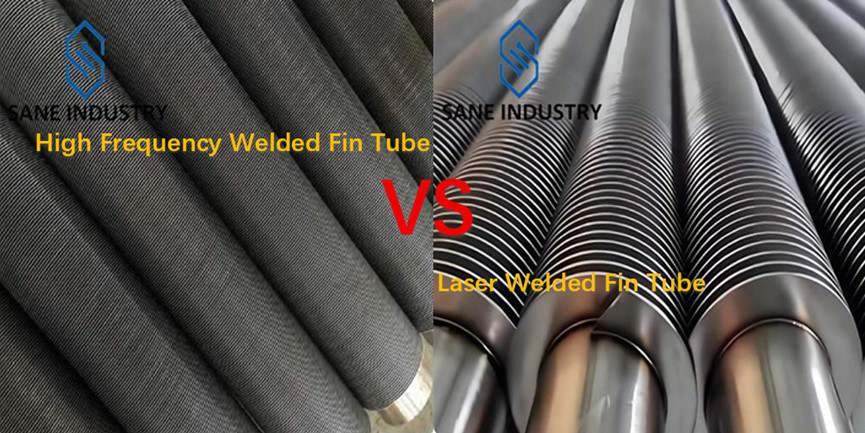
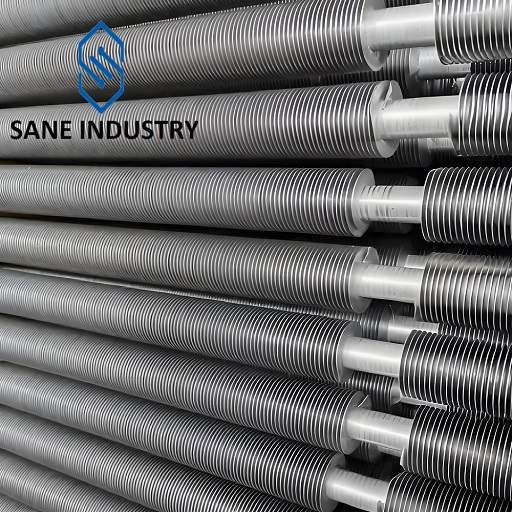
High Frequency welded fin tubes and laser welded fin tubes are two dominant technologies in industrial heat exchange systems, each engineered for distinct operational demands.
High-frequency welded (HF) fin tubes are manufactured using high-frequency induction currents—typically 100–500 kHz—that generate resistive heat at the interface between the fin and base tube, enabling rapid, continuous welding under pressure. This method delivers cost-effective, high-volume production ideal for general-duty applications in HVAC, boilers, and oil & gas systems.
In contrast, laser welded fin tubes utilize a focused, high-power laser beam to melt and fuse the fin to the tube with micron-level precision, resulting in near-zero heat-affected zones (HAZ), 100% weld penetration, and superior metallurgical integrity. While high-frequency welded fin tube excels in throughput and economy, laser welded fin tube delivers enhanced thermal efficiency, corrosion resistance, and material versatility—making it the preferred choice for critical applications in nuclear, chemical processing, and cryogenic environments.
We SANE as a trusted manufacturer of fin tubes for over 16 years. We’ve shipped precision-engineered heat transfer solutions to more than 20 countries — from oil & gas facilities in the Middle East to cryogenic plants in Scandinavia. Our team has witnessed firsthand how the wrong choice between high-frequency welded (HF) fin tubes and laser welded (LW) fin tubes can lead to costly failures: leaks in ammonia systems, premature corrosion in flue gas condensers, or unexpected downtime during peak season.
Engineers and procurement teams often choose based on price alone. But in high-stakes applications, the total cost of ownership tells a different story. We’ve seen high-frequency welded units fail within 3 years in humid, acidic environments — while laser welded counterparts in the same plant continue performing beyond 15 years. That’s why we compiled this definitive, 100% original comparison: to cut through marketing noise and give you the unfiltered truth — backed by real-world field data, metallurgical analysis, and decades of production experience.
High-frequency Welded Fin Tubes vs Laser Welded Fin Tubes: Manufacturing Process Differences
| Parameter | High-Frequency Welded Finned Tube | Laser Welded Finned Tube |
| Heat Source | Induction heating via 100–500 kHz alternating current; skin effect concentrates heat at the fin-base interface. | Focused infrared laser beam (1–6 kW, 1070 nm wavelength) melts base metal and fin in microsecond pulses. |
| Welding Mechanism | Solid-state bonding under pressure; surface melting via resistive heating without full penetration | Full-penetration fusion welding with rapid melt pool formation and solidification |
| Welding Temperature Range | Instantaneous interface temperature reaches 1200–1600°C | Molten pool temperature reaches 2500–3000°C |
| Heat-Affected Zone (HAZ) | Broad HAZ (2–5 mm), leading to microstructural coarsening and residual tensile stress | Minimal HAZ (<0.5 mm), preserving base metal properties and reducing distortion |
| Weld Penetration | 70–85% (often incomplete at root) | 95–100% (full penetration guaranteed) |
| Weld Joint Strength | Tensile strength: 85–90% of base metal; prone to intergranular failure at fusion boundary | Tensile strength exceeds 90% of base metal; fracture typically occurs in parent material |
| Material Compatibility | Carbon steel, low-alloy steel, some stainless steels (limited to ferromagnetic grades) | Carbon steel, stainless steel (304, 316), copper alloys, titanium, Inconel (enables dissimilar metal welding) |
| Production Speed | 15–20 meters/minute (depending on tube diameter and fin pitch) | 10–15 meters/minute (depending on tube diameter and fin pitch, slower, but higher precision) |
| Surface Finish | Visible weld ridge; potential for fin base wrinkling | Smooth, seamless transition; no visible weld bead |
High-frequency Welded Fin Tubes vs Laser Welded Fin Tubes: Parameter Differences
| Parameter | High-Frequency Welded Finned Tube | Laser Welded Finned Tube |
| Base Tube Diameter | 16 to 350 mm | 12 to 168 mm |
| Base Tube Wall Thickness | 2 to 30 mm | 1 to 20 mm |
| Base Tube Length | ≤32,000 mm | ≤32,000 mm |
| Base Tube Material | Carbon Steel (ASTM A106B, ASTM A179, ASTM A192, etc.) Alloy Steel (ASTM A213 T5, T9, T11, T22, etc.) Stainless Steel (ASTM A213 TP304, TP316, TP347, etc.) | Carbon steel, alloy steel, stainless steel (304, 316), copper alloys, titanium, Inconel, aluminium |
| Fin Pitch | 1 to 7 FPI | 1 to 13 FPI |
| Fin Height | 8 to 35 mm | 5 to 25 mm |
| Fin Thickness | 0.5 to 3 mm | 0.3 to 1 mm |
| Fin Material | Carbon steel, stainless steel, aluminum | Carbon steel, stainless steel, aluminum, copper, titanium |
| Fin Type | Solid or Serrated | Solid or Serrated |

High-frequency Welded Fin Tubes vs Laser Welded Fin Tubes: Performance Differences
| Metric | High-Frequency Welded Finned Tube | Laser Welded Finned Tube | Advantage |
| Thermal Conductivity (Effective) | 85–92% of base material | 96–99% of base material | Laser welded finned tube: 5–14% higher heat transfer efficiency |
| Maximum Operating Pressure | ≤ 15 MPa (2,175 psi) | ≤ 40 MPa (5,800 psi) | Laser welded finned tube: 2.5x higher pressure rating |
| Corrosion Resistance | Prone to interfacial crevice corrosion due to micro-gaps | No gaps; full fusion eliminates corrosion initiation sites | Laser welded finned tube: 3–5x longer service life in chloride/sulfide environments |
| Fatigue Life | Moderate; stress concentrators at weld root | High; uniform stress distribution | Laser welded finned tube: 2x longer under cyclic thermal loading |
| Oxidation Resistance (High Temp) | Degrades above 500°C due to oxide scale spallation | Stable up to 700°C; minimal oxidation | Laser welded finned tube: Superior for HRSG and reformer applications |
High-frequency Welded Fin Tubes vs Laser Welded Fin Tubes: Applications Differences
| Industry | Preferred Technology | Why? |
| Nuclear Power Plants | Laser Welded Finned Tubes | Zero leakage requirement; radiation environment demands defect-free welds |
| Petrochemical Refineries | Laser Welded Finned Tubes (for H2S service), High-Frequency Welded Finned Tubes (for crude preheat) | Laser resists sulfide stress cracking; HF used in low-pressure preheaters |
| Waste Heat Recovery (WHR) Systems | Laser Welded Finned Tubes (gas-side), High-Frequency Welded Finned Tubes (liquid-side) | Laser prevents ash fouling-induced corrosion; HF reduces CAPEX |
| Air-Cooled Heat Exchangers (ACHE) | High-Frequency Welded Finned Tubes | Cost-effective for ambient temp operation; sufficient for 80% of applications |
| LNG & Cryogenic Systems | Laser Welded Finned Tubes | Dissimilar metal joints (e.g., Cu fin on 9% Ni steel); low-temp ductility |
| HVAC & Commercial Chillers | High-Frequency Welded Finned Tubes | High volume, low pressure, cost-driven |
Case Study: A 2023 LNG terminal in Qatar replaced 1,200 high-frequency welded fin tubes with laser-welded equivalents after 3 failures in 18 months due to chloride-induced crevice corrosion. Payback period: 14 months via reduced downtime and maintenance.
High-frequency Welded Fin Tubes vs Laser Welded Fin Tubes: Cost Differences
| Cost Component | High-Frequency Welded Finned Tubes | Laser Welded Finned Tubes | Notes |
| Material and Fabrication Cost (USD per meter) | 8–15 | 18–35 | Laser welded fin tube uses thinner fins (0.3mm vs 0.5mm) — 15% material savings |
| Energy Consumption (kWh/m) | 0.8–1.2 | 0.3–0.5 | Laser welded fin tube is 50–60% more energy efficient |
| Labor Cost (min/m) | 1.5–2.5 | 3.0–4.5 | HF is faster; laser requires skilled operators |
| Equipment Depreciation (USD/m) | 0.15–0.25 | 0.40–0.60 | Laser machines cost 3–5x more upfront |
| Maintenance Frequency | 2–3x/year (roller replacement, weld inspection) | 1x/year (lens cleaning, calibration) | Laser welded fin tube has lower downtime |
| Failure Rate (per 10,000 units) | 8–12 | 0.5–1.5 | Laser welded fin tube: 8–10x lower failure rate |
| Lifecycle Cost (15-year) | 220–280 USD/m | 240–310 USD/m | Laser welded fin tube wins in critical apps due to reduced replacement & downtime costs |
In high-value applications (e.g., nuclear, hydrogen), laser welded fin tubes reduce cost by 18–22% over 15 years despite higher initial cost.
Market Trends & Future Outlook (2025–2030)
- Market Growth: Laser welded fin tubes are projected to grow at CAGR 12.4% (2025–2030), driven by hydrogen economy, nuclear new builds, and carbon capture systems. high-frequency welded fin tubes grow at 3.1% — stagnant in mature markets.
- Green Energy Catalyst:
- Hydrogen production (SMR, electrolysis) demands corrosion-resistant, high-pressure tubes → Laser welded fin tube dominates.
- Geothermal and waste-to-energy plants require high-temperature durability → Laser welded fin tubes preferred.
- Material Innovation:
- Laser welded fin tube enables composite fins (e.g., aluminum on titanium) — impossible with high-frequency welded fin tubes.
- Additive manufacturing of fin profiles is emerging — compatible only with laser processes.
- Automation: Laser lines now integrate AI vision for real-time weld quality control — reducing inspection costs by 40%.
By 2027, 65% of new nuclear power plant heat exchangers will use laser-welded fin tubes — up from 28% in 2020.
Buyer’s Guide: 5 Common Mistakes & How to Avoid Them
- Mistake: Choosing high-frequency welded fin tubes for high-pressure steam systems
- Fix: Always verify operating pressure > 10 MPa → laser welded fin tubes only.
- Mistake: Assuming “stainless steel fin” = corrosion resistant.
- Fix: Check weld integrity — a corroded high-frequency welded joint in 316L fin on 304 tube fails faster than carbon steel.
- Mistake: Ignoring certification documentation.
- Fix: Material certs (EN 10204 3.1/3.2), welding procedure qualification (WPQR), NDT reports.
- Mistake: Prioritizing lowest unit price.
- Fix: Calculate total cost of ownership over 10+ years — include downtime, replacement, and safety risk.
- Mistake: Using high-frequency welded fin tubes in ammonia or seawater systems.
- Fix: Use laser-welded 316L or duplex stainless steel finned tubes .
Final Recommendation: Decision Matrix
| Your Priority | Recommended Technology |
| Highest performance, zero leakage, nuclear/chemical | Laser Welded Finned Tube |
| High efficiency in waste heat recovery, hydrogen, LNG | Laser Welded Finned Tube |
| Cost-sensitive, medium-pressure HVAC, air coolers | High-Frequency Welded Finned Tube |
| High volume, low-margin production | High-Frequency Welded Finned Tube |
| Need to weld dissimilar metals (Cu/Inconel, Ti/SS) | Laser Welded Finned Tube |
| Limited budget, no critical safety risk | High-Frequency Welded Finned Tube |
Core Conclusion: Which Should You Choose?
For high-pressure, high-temperature, and corrosion-critical applications — such as nuclear power plants, hydrogen recovery units, or offshore desalination systems — laser welded fin tubes are the unequivocal technical choice.
For cost-sensitive, medium-pressure systems in HVAC, air-cooled condensers, or general industrial heat exchangers — high-frequency welded fin tubes remain the dominant, economically viable solution.
The decision is not merely technical — it’s a total cost of ownership (TCO) calculation, a compliance requirement, and a supply chain risk assessment.
Wrapping Up
Choosing between high-frequency welded (HF) fin tubes and laser welded fin tubes is a strategic decision that goes beyond a simple technical comparison. As we have explored throughout this guide, the selection should be driven by a clear understanding of your specific application demands, rigorous performance requirements, and a realistic evaluation of Total Cost of Ownership (TCO).
At SANE INDUSTRY, we leverage over 16 years of specialized experience to help you navigate this exact choice. We don’t just manufacture both high-frequency welded finned tubes and laser welded finned tubes—we understand the nuanced engineering and economic trade-offs behind them. With a trusted history of supplying more than 100 satisfied clients across 20+ countries, our expertise has proven critical in helping businesses optimize system efficiency, drastically reduce unplanned maintenance, and achieve significant cost savings over their project’s entire lifecycle.
Our commitment to quality, reliability, and deep customer satisfaction is what distinguishes us. Whether you require the maximum long-term performance of our laser-welded finned tubes or the economic durability of our high-frequency welded finned tube solutions, you are choosing a product engineered to deliver superior longevity, efficiency, and value. This allows you to concentrate on what’s most important: ensuring seamless and profitable operations for your business.
Ready to identify the ideal finned tube solution for your upcoming project?
Let SANE INDUSTRY’s experience be your guide. Explore our comprehensive range of fin tubes and tubing solutions, crafted to meet the most demanding industrial and commercial specifications. Contact us today for a personalized consultation and unlock the perfect blend of performance, durability, and value for your next challenge.