Finned tube heat exchangers are specialized thermal transfer devices designed to enhance heat exchange between two fluids with significantly different heat transfer coefficients. These exchangers are particularly effective when one fluid (typically a gas) has a much lower heat transfer coefficient than the other (usually a liquid). By attaching extended surfaces (fins) to the tubes, these heat exchangers dramatically increase the surface area available for heat transfer, making them more efficient than plain tube designs.
We SANE are a 16-year fin tubes manufacturer. Our high-quality fin tubes are widely used by world famous companies. We are experts in the finned tube field. To inform potential customers about the fundamental aspects of finned tube heat exchangers, including their design, functionality, and applications. This helps bridge knowledge gaps for buyers unfamiliar with the technology. That’s why we wrote this guide.
What Is a Finned Tube Heat Exchanger?
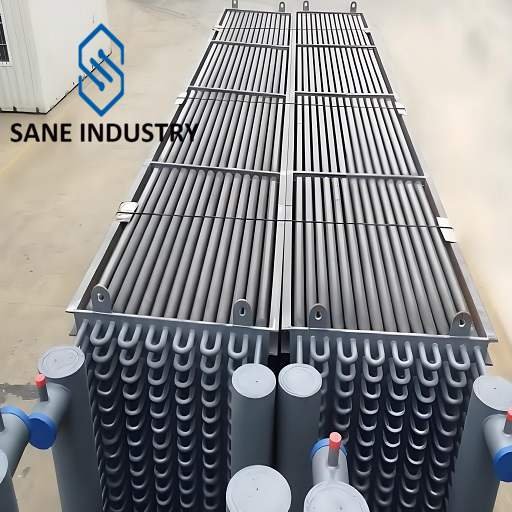
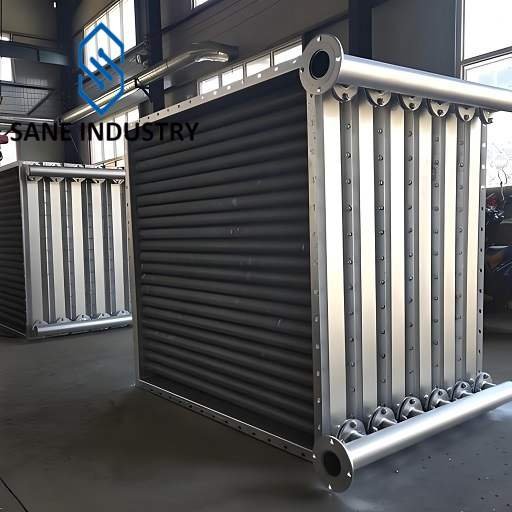
A finned tube heat exchanger consists of tubes with extended surfaces (fins) attached to their outer surfaces. The fins can be either integral (formed as part of the tube) or attached through mechanical means. These heat exchangers are classified as “extended surface” or “secondary surface” heat exchangers because the fins provide additional surface area beyond the base tube surface.
Finned tube heat exchangers are characterized by their ability to provide large heat transfer surface areas in compact volumes, making them ideal for applications where space is limited. The fins can be arranged in various patterns and configurations to optimize performance for specific applications.
How Does a Finned Tube Heat Exchanger Work?
The operation of finned tube heat exchangers is based on three fundamental heat transfer mechanisms:
- Convective heat transfer from fluid to the inner wall of the tube: The hotter fluid transfers heat to the inner surface of the tube through convection.
- Conductive heat transfer through the tube wall: Heat conducts through the material of the tube from the inner wall to the outer wall.
- Convective heat transfer from the outer tube wall to the outside fluid: Heat is transferred from the outer tube surface (and fins) to the cooler fluid through convection.
The fins significantly enhance the heat transfer process by:
- Increasing the surface area available for heat exchange
- Disrupting the boundary layer of the fluid flowing over the surface
- Promoting turbulence in the fluid flow
- Allowing for more efficient heat transfer between the tube and the surrounding fluid
What Makes Up a Finned Tube Heat Exchanger? Key Parts & Structure
The key components and structural features of finned tube heat exchangers are as follows:
- Base Tube (Primary Conduit)
The central cylindrical tube, typically made of copper, aluminum, or carbon steel, carries the primary fluid (e.g., water, steam, refrigerant). Its wall thickness and material selection are optimized for pressure rating and thermal conductivity.
- Fins (Heat Transfer Extensions)
Thin metallic fins are radially extended from the outer surface of the base tube to increase the effective heat transfer area. Fins are typically made of aluminum or copper for high thermal conductivity and are engineered to minimize aerodynamic drag while maximizing surface exposure.
- Tube Sheet (Tube Plate)
A thick, perforated plate that securely holds and seals the ends of multiple tubes, providing structural support and fluid isolation between the tube-side and shell-side domains. It ensures leak-tight integrity under pressure differentials.
- Header (Manifold)
Enclosed chambers at each end of the tube bundle that distribute or collect the internal fluid. Headers are designed with inlet/outlet nozzles and internal baffles to promote uniform flow distribution and minimize dead zones.
- External Enclosure (for Air-Cooled Systems)
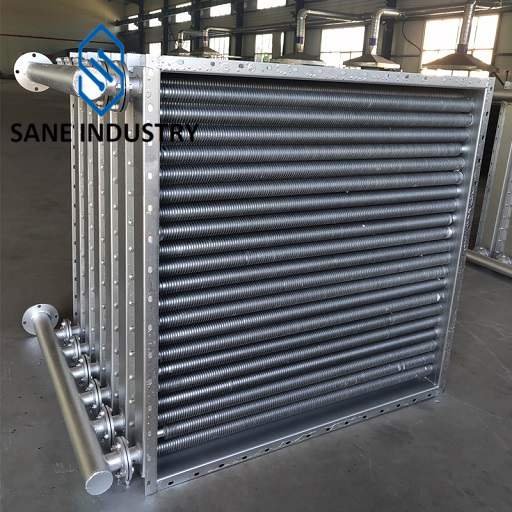
In air-cooled heat exchangers, the finned tube bundle is housed within a frame structure, often with integrated fans to force airflow across the fins. The enclosure may include louvers, shrouds, or ducting to optimize air distribution and minimize recirculation.
What Are The Applications of Finned Tube Heat Exchangers?
Finned tube heat exchangers find wide application across various industries due to their versatility and efficiency:
- HVAC Systems: Used in air conditioning units, fan coil systems, and ventilation equipment for heating and cooling air
- Refrigeration: Employed in evaporators, condensers, and heat recovery systems in refrigeration units
- Automotive: Used in vehicle radiators, charge air coolers, and engine cooling systems
- Power Generation: Applied in steam condensers, cooling towers, and waste heat recovery systems
- Chemical Processing: Used for heating and cooling process fluids in chemical plants
- Oil & Gas: Employed in refinery heat exchangers and gas cooling applications
- Industrial Heating: Used in industrial ovens, dryers, and process heating systems
- Waste Heat Recovery: Applied in various industrial processes to capture and utilize waste heat
The adaptability of finned tube heat exchangers makes them suitable for both heating and cooling applications across these diverse industries, with their compact design being particularly advantageous in space-constrained installations.
8 Key Advantages of Finned Tube Heat Exchangers
Finned tube heat exchangers offer several distinct advantages over other heat exchanger types:
- Enhanced Heat Transfer: Fins significantly increase the surface area available for heat transfer, improving overall efficiency
- Compact Design: High surface-area-to-volume ratio makes them space-efficient compared to other heat exchanger types
- High Pressure Resistance: Can withstand high pressures on the tube side, making them suitable for demanding applications
- Versatility: Can handle a wide range of temperatures and pressures, depending on material selection
- Cost-Effective: Generally more economical than plate heat exchangers for large-scale applications
- Durability: Robust construction allows for long-term operation in harsh environments
- Ease of Maintenance: Many designs allow for relatively straightforward cleaning and maintenance procedures
- Customizability: Can be tailored to specific application requirements through various fin configurations and materials
These advantages make finned tube heat exchangers the preferred choice for many industrial heat transfer applications, particularly when gas-to-liquid heat exchange is required.
What Are The Disadvantages of Finned Tube Heat Exchangers?
Despite their numerous advantages, finned tube heat exchangers also have some limitations:
- Corrosion Susceptibility: Fins are prone to corrosion, especially in harsh environments or with certain fluid combinations
- Fouling Potential: Fins can accumulate deposits, reducing heat transfer efficiency over time
- Pressure Drop: Finned designs typically exhibit higher pressure drop compared to smooth-tube heat exchangers
- Material Limitations: Temperature constraints based on fin bonding materials
- Cleaning Challenges: Fins can make mechanical cleaning more difficult compared to smooth-tube designs
- Manufacturing Complexity: Some finned tube designs require specialized manufacturing processes
- Vibration Issues: Fins may be susceptible to vibration-induced failure under certain flow conditions
- Aesthetic Concerns: In architectural applications, finned designs may not be as visually appealing as smooth surfaces
These disadvantages highlight the importance of proper material selection, design considerations, and maintenance practices when implementing finned tube heat exchangers in industrial applications.
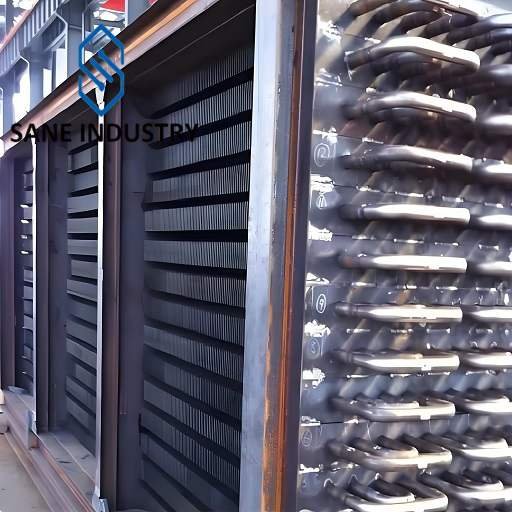
What Are The Types Of Finned Tube Heat Exchangers?
Finned tube heat exchangers are classified primarily by fin material, manufacturing method, and structural configuration, as defined in international engineering literature and industry standards. Below is a structured overview of the main types:
- Finned Tube Heat Exchanger Type by Fin Material
| Material Type | Description | Key Characteristics | Typical Applications |
| Aluminum Finned Tube Heat Exchanger | Aluminum fins bonded to a metal base tube | High thermal conductivity; requires surface treatment for corrosion resistance | Air conditioners, air coolers, low-temperature systems |
| Copper Finned Tube Heat Exchanger | Copper fins bonded to copper or steel base tubes | Exceptional thermal performance; excellent corrosion resistance | Precision refrigeration, HVAC condensers, steam condensation systems |
| Steel-Aluminum Composite Finned Tube Heat Exchanger | Carbon steel or stainless steel base tube with aluminum fin | Balances mechanical strength and high thermal conductivity; cost-effective | Industrial boilers, waste heat recovery systems |
| Stainless Steel Finned Tube Heat Exchanger | Fully stainless steel construction (tube and fins) | Resistant to aggressive media, high temperature, and high pressure; higher cost | Chemical processing, seawater cooling, specialized applications |
- Finned Tube Heat Exchanger Type by Manufacturing Process
| Manufacturing Process Type | Description | Characteristics | Typical Applications | Example |
| Roll-Bonded | Fins are integrally formed with the tube via high-pressure rolling | Zero contact thermal resistance, high bond strength, pressure-resistant | Industrial steam heaters, air preheaters | Integral High Finned Pipe |
| Wound/Wrapped | A metal strip is helically wound and secured via mechanical tension or adhesive | cost-effective but prone to loosening under thermal cycling | Boiler economizers, greenhouse heating, chemical heat exchangers | L, LL, KL Finned Tubes |
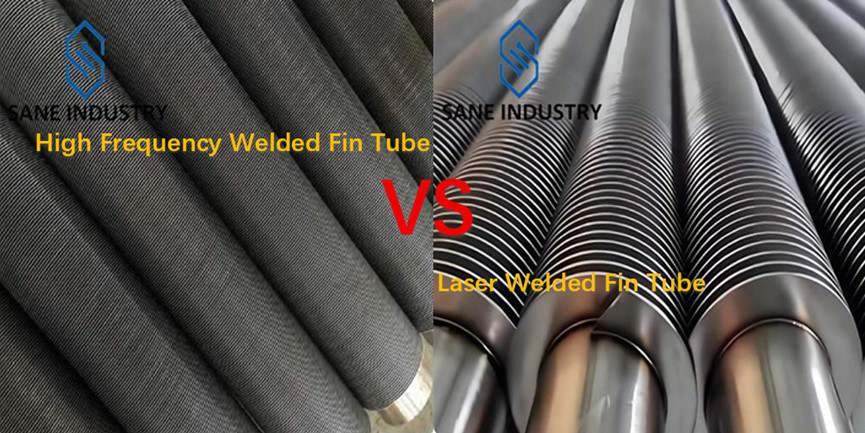
| High-Frequency Welded | Fins are locally fused to the tube wall using high-frequency current | Dense weld seams, high heat transfer efficiency, long service life | Hot air heating, drying systems | High Frequency Welded Solid Finned Tubes |
| Insert Fins | Fins are mechanically inserted into slots machined into the tube wall | Simple process; higher thermal resistance and risk of loosening | Low-pressure, infrequent-use applications | G Type Embedded Finned Tubes |
| Extruded Fins | Fins are formed by extruding the base material | High mechanical strength, good thermal contact | HVAC and Refrigeration Systems, refinery heat exchangers | Extruded Finned Tubes |
- Finned Tube Heat Exchanger Type by Geometry
| Geometry Type | Description | Performance Advantages | Typical Applications |
| Circular Fin Tube Heat Exchanger | Most common type of finned tube heat exchanger. Fins are circular in shape, surrounding the tube | Simple to manufacture; suitable for low-velocity airflow | air-cooled condensers, evaporators, and radiators |
| Plate Fin Tube Heat Exchanger | Fins are flat plates attached to the tubes | Provides good heat transfer with moderate pressure drop | Often used in HVAC systems and refrigeration |
| Helical Fin Tube Heat Exchanger | Fins are wound helically around the tubes | Enhances turbulence and heat transfer | Used in applications requiring compact heat exchangers |
| Longitudinal Fin Tube Heat Exchanger | Rectangular fins aligned parallel to the tube axis | Fins increase surface area, boosting thermal efficiency | commonly used in air-cooled systems for low-turbulence flow. |
| U-Shaped Fin Tube Heat Exchanger | Tubes are bent into U-shapes with fins | Can withstand high temperatures and pressures | Used in steam heating and waste heat recovery |
| Coil Heat Exchanger | Tubes wound into helical or spiral coils | compact, high-performance heat exchange | commonly used in HVAC, refrigeration, and industrial applications |
How To Choose The Right Finned Tube Heat Exchanger? Step-by-Step Guide
Selecting the optimal finned tube heat exchanger requires a systematic evaluation of thermal, mechanical, and operational parameters. Below is a step-by-step guide:
Step 1: Define the Thermal and Fluidic Requirements
Begin by quantifying the core operational parameters:
- Heat load (kW or BTU/hr)
- Inlet/outlet temperatures for both fluids (hot and cold streams)
- Flow rates and pressure drops allowable on each side
- Fluid properties: viscosity, thermal conductivity, specific heat, and phase (gas/liquid)
Critical insight: Finned tubes are primarily used when one fluid has low convective heat transfer coefficient—typically air or other gases. If both fluids are liquids, bare tubes are usually more economical.
Step 2: Select the Appropriate Fin Geometry
Fin configuration directly impacts performance and fouling resistance:
| Fin Tube Type | Advantages | Disadvantages | Applications |
| Spiral Fin Tube | High heat transfer, compact, low cost | High pressure drop, fouling-prone | Waste heat recovery, economizers, HVAC |
| Longitudinal Fin Tube | Low pressure drop, simple, robust | Low heat transfer, poor cross-flow | Condensers, air-cooled exchangers, drying |
| Serrated Fin Tube | Fouling-resistant, high heat/length | Costly, stress concentration | Flue gas boilers, particulate coolers, furnace exhaust |
| H-type Fin Tube | High rigidity, efficient conduction, low drop | Complex fab, high material use | Refrigeration, steam economizers, cryogenic |
Step 3: Choose Material Based on Corrosion and Thermal Environment
Material selection must align with fluid compatibility and operating temperature:
| Material | Thermal Conductivity (W/m·K) | Corrosion Resistance | Typical Applications |
| Aluminum | ~205 | Excellent in dry air; poor in saline or acidic environments | Residential/commercial HVAC, automotive radiators |
| Copper | ~385 | Good in water; requires coating in aggressive gases | High-efficiency refrigeration, condensers |
| Stainless Steel (304/316) | ~15–20 | Superior in chlorides, acids, high-temp gases | Chemical processing, flue gas heat recovery |
| Carbon Steel (with coating) | ~50 | Acceptable with epoxy or zinc coating | Low-cost industrial air coolers |
Step 4: Calculate Key Performance Parameters
Use empirical formulas to estimate critical design values:
- Fin Efficiency
- Overall Heat Transfer Coefficient
- Fouling Factor Selection
Step 5: Optimize Tube Layout and Number of Rows
- Tube pitch: Use staggered arrangement for higher heat transfer; inline for easier cleaning.
- Number of rows: 2–4 rows: Common for HVAC, 6–12 rows: Typical for power plant air coolers.
- Air velocity: Maintain 2–5 m/s to balance heat transfer and fan power.
Rule of thumb: Each additional row increases heat transfer by ~15–20% but raises pressure drop by 30–50%.
Step 6: Validate Against Industry Standards
Ensure compliance with:
- ASME BPVC Section VIII: The legal standard in the U.S. for designing and building pressure vessels, including heat exchangers, ensuring structural integrity under pressure
- TEMA (Tubular Exchanger Manufacturers Association): Mechanical design and tolerances
- API 660: Specific for refinery and petrochemical heat exchangers, demanding high performance and material specs for tough conditions
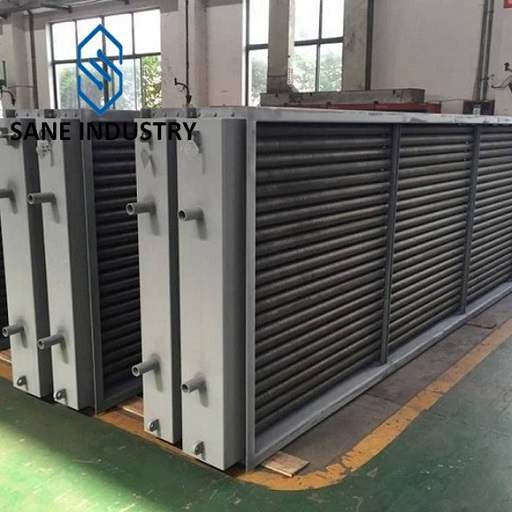
Comparison with Other Heat Exchanger Types
Finned Tube Heat Exchanger vs Shell-and-Tube Heat Exchangers
| Feature | Finned Tube Heat Exchanger | Shell-and-Tube Heat Exchanger |
| Heat Transfer Efficiency | Higher (due to fins) | Moderate |
| Compactness | Very Compact | Less Compact |
| Pressure Drop | Higher | Lower |
| Fouling Resistance | Lower | Higher |
| Cost | Moderate | Higher |
| Maintenance | More Difficult | Easier |
| Temperature Range | Limited by fin bonding | Wide |
Finned tube heat exchangers are generally more space-efficient and cost-effective for gas-liquid applications, while shell-and-tube designs offer better fouling resistance and are easier to maintain.
Finned Tube Heat Exchanger vs Plate Heat Exchangers
| Feature | Finned Tube Heat Exchanger | Plate Heat Exchanger |
| Heat Transfer Efficiency | Higher | Very High |
| Compactness | Compact | Very Compact |
| Pressure Drop | Higher | Very High |
| Fouling Resistance | Lower | Very Low |
| Cost | Low-Medium | Medium-High |
| Maintenance | Difficult | Easy |
| Temperature Range | Limited by fin bonding | Wide |
Plate heat exchangers offer superior heat transfer efficiency and fouling resistance but at higher cost and with more stringent pressure drop limitations compared to finned tube designs.
Finned Tube Heat Exchanger Maintenance and Operation
Proper maintenance and operation are crucial for ensuring long-term performance and reliability of finned tube heat exchangers:
Maintenance Procedures
- Regular Cleaning: Remove deposits from fin surfaces to maintain heat transfer efficiency
- Inspection: Check for corrosion, fin damage, and tube integrity during maintenance shutdowns
- Leak Testing: Periodically test for leaks in the tube bundle
- Vibration Analysis: Monitor for vibration-induced failures, especially in high-velocity applications
Operating Guidelines
- Startup Procedures: Gradually introduce process fluids to avoid thermal shock
- Shutdown Procedures: Properly depressurize and drain the heat exchanger when taken out of service
- Performance Monitoring: Track temperature differentials, pressure drops, and heat transfer rates over time
- Operating Parameters: Maintain within design limits for temperature, pressure, and flow rates
Maintenance Frequency
- Routine Inspections: Visual inspections should be conducted monthly or quarterly
- Cleaning Cycles: Depends on fouling tendency; may range from monthly to annually
- Major Overhauls: Complete inspection and refurbishment every 3-5 years
Adhering to these maintenance and operating guidelines helps maximize the service life and efficiency of finned tube heat exchangers while minimizing unexpected downtime.
Finned Tube Heat Exchanger Future Trends and Developments
The field of finned tube heat exchanger technology continues to evolve with several notable trends:
- Material Innovations: Development of corrosion-resistant coatings and alloys to extend service life
- Advanced Manufacturing: Additive manufacturing techniques for complex fin geometries
- Hybrid Designs: Combination of finned tubes with other heat transfer enhancement techniques
- Smart Heat Exchangers: Integration of sensors for real-time performance monitoring
- Sustainability Focus: Improved designs for energy efficiency and reduced environmental impact
- Computational Fluid Dynamics: Enhanced modeling for optimized heat exchanger performance
- Nanofluid Applications: Use of nanofluids for improved heat transfer characteristics
- Modular Designs: Easily scalable heat exchanger systems for various applications
These advancements promise to further improve the performance, efficiency, and reliability of finned tube heat exchangers in the coming years, solidifying their position as a critical technology in industrial heat transfer applications.
Wrapping Up
Finned tube heat exchangers represent a versatile and efficient solution for a wide range of industrial heat transfer applications. Their ability to enhance heat transfer through extended surface area, combined with their compact design and cost-effectiveness, makes them indispensable in many engineering systems. By carefully considering design parameters, maintenance requirements, and comparative advantages, engineers can effectively utilize finned tube heat exchangers to meet diverse thermal management challenges across various industries.
With over 16 years of specialized expertise in finned tube, finned piping, and tubing solutions, We SANE has empowered more than 100 industrial clients across 20+ nations to achieve peak thermal performance and operational resilience. Our finned tubes offer durable, high-performance solutions that meet a variety of industrial and commercial needs.
Ready to find the perfect finned tube solutions for your heat exchangers? Feel free to contact with us via allen@sanesteel.com.